

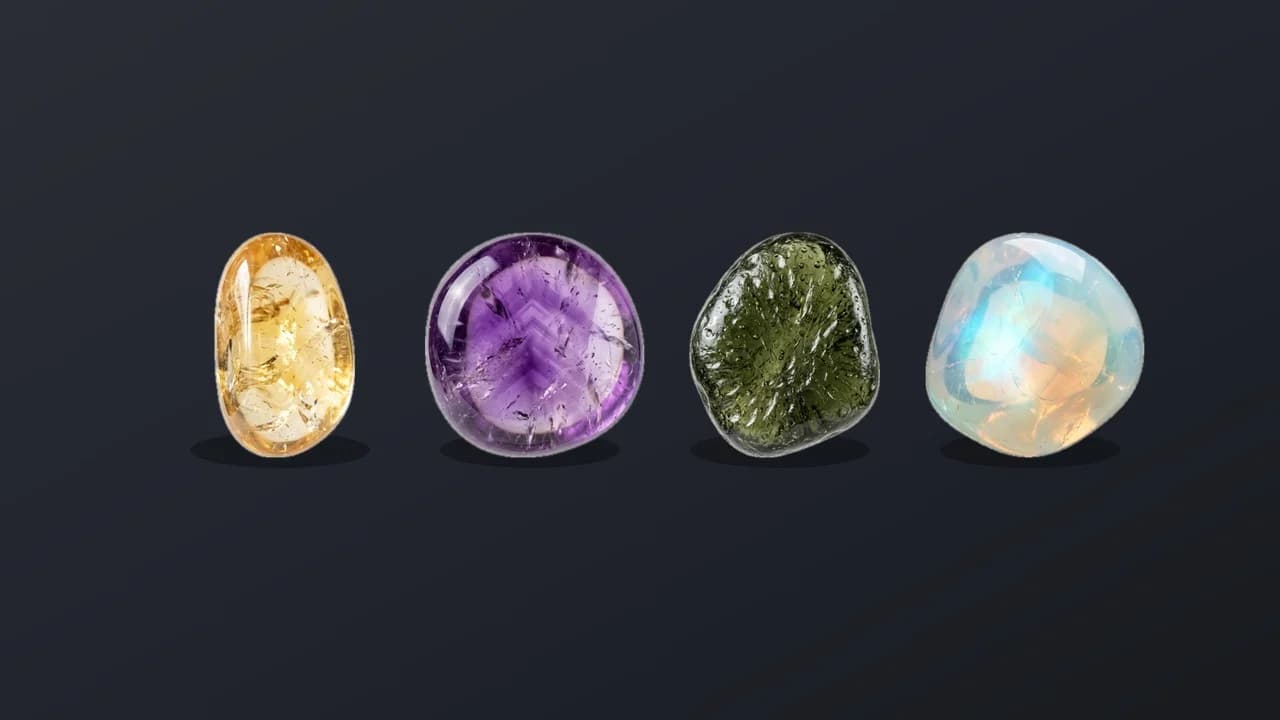
As interest in crystal collecting and metaphysics has skyrocketed worldwide, so too has the market for laboratory simulants, glass imitations, dyed stones, and artificially altered minerals. Sellers on online marketplaces frequently market inexpensive minerals under exotic trade names or misrepresent lab-baked rocks as rare specimens.
Knowing how to separate authentic Earth-formed minerals from synthetic imitations preserves your wallet and ensures the integrity of your collection. Here are the most common fake crystals on the market and the tests you can perform at home to spot them.
🔍 The Top 5 Most Common Fakes & Misnomers
1. Baked Amethyst Sold as "Natural Citrine"
- The Trick: Real citrine is rare and prized. Industrial processors take cheap Brazilian amethyst geodes and heat them in industrial kilns to over 900°F (500°C), turning the purple iron inclusions burnt dark amber or rusty orange.
- How to Tell:
- Heat-Treated Amethyst: Deep dark burnt-orange or brownish-amber tips with bright white chalky quartz bases, clustered tightly like a geode cavity.
- Natural Citrine: Soft, uniform, pale honey or champagne-yellow throughout with no stark white quartz base. Often forms long prismatic single crystals or cathedral formations rather than geode crusts.
2. Dyed Howlite & Magnesite Sold as "Turquoise"
- The Trick: Genuine turquoise is increasingly scarce and expensive. Howlite and magnesite are naturally white, chalky minerals with gray or black matrix veins that absorb blue and green dyes effortlessly.
- How to Tell:
- Acetone Q-Tip Test: Dip a cotton swab in 100% pure acetone or nail polish remover and rub a discrete spot on the stone. If turquoise-blue pigment bleeds onto the cotton swab, it is dyed.
- Scratch Test: Howlite is soft (Mohs 3.5); turquoise is harder (Mohs 5–6).
3. "Opalite" & "Goldstone" (Man-Made Glasses)
- The Trick: Often sold alongside natural stones with metaphysical claims of purity and vitality.
- The Truth:
- Opalite: A synthetic man-made glass (doped with dolomite/fluorite) designed to mimic moonlight opal and moonstone. It produces an artificial blue-yellow opalescence (tyndall scattering) and contains perfect clarity with occasional micro air bubbles.
- Goldstone (Blue, Green, Red): Glass infused with tiny microscopic copper crystals suspended evenly in the melt. Completely synthetic, created by Venetian glassmakers in the 17th century.
4. Fake Green Moldavite (Cast Green Glass)
- The Trick: Moldavite is a rare tektite formed 15 million years ago by a meteorite impact in the Czech Republic. Genuine moldavite is expensive ($40–$100+ per gram), leading counterfeiters to pour melted green bottle glass into silicone molds.
- How to Tell:
- Surface Texture: Fake moldavite looks wet, shiny, and melted like sea glass. Genuine moldavite has sharp, jagged, pitted, and deeply furrowed aerodynamic craters (sculpting).
- Inclusions Under 10x Loupe: Genuine moldavite contains stretched, swirling flow lines (schlieren) and elongated, torpedo-shaped bubbles of lechatelierite (pure fused silica). Cast glass contains spherical, round bubbles and uniform texture.
5. Clear Glass or Resin Sold as "Clear Quartz"
- The Trick: Molded molten lead glass or acrylic resin sold as polished generator points, wands, and spheres.
- How to Tell:
- Temperature: Real quartz is a natural thermal conductor; it feels cold to the touch and takes several minutes to warm against your skin. Glass and plastic warm up almost instantly.
- Magnification Inversion: Real quartz exhibits double refraction (birefringence) or slight optical distortion. Glass will show perfectly rounded spherical air bubbles trapped inside.
🛠️ 4 Diagnostic Home Tests for Collectors
-
The Temperature / Thermal Test:
- Touch the stone to the tip of your nose or cheek. Natural stones absorb ambient heat slowly and feel distinctly ice-cold. Acrylics, resins, and thin glass warm immediately.
-
The Mohs Hardness Scratch Test:
- Real quartz family stones (Amethyst, Citrine, Agate, Jasper) have a Mohs hardness of 7.0. A common carbon steel knife or nail has a hardness around 5.5 to 6.5. A steel knife cannot scratch real quartz. If a knife easily scratches your "citrine", it is calcite, fluorite, or soft glass.
-
UV Blacklight Inspection (365nm / 395nm):
- Many synthetic resins and dyes glow intensely neon under longwave UV light. Natural stones like Yooperlite (sodalite) and Ruby fluoresce naturally, but blotchy, patchy surface glow along hairline cracks reveals dye infiltration.
-
The Weight / Density Check:
- Pick up the specimen. Natural crystalline minerals (especially Hematite, Pyrite, Fluorite, and Tourmaline) feel noticeably heavy (dense heft) for their size. Resin and hollow fakes feel deceptively light and hollow.